Testing, Security & Cost Controls
GitHub Actions Quality Gates
The main branch workflow runs four independent jobs before a change is
considered to have passed the quality gate:
- Scan the full Git history for secrets with Gitleaks.
- Compile the backend and run 204 pytest tests.
- Run frontend tests and create the production build.
- Check Terraform formatting,
init -backend=false, andvalidate.
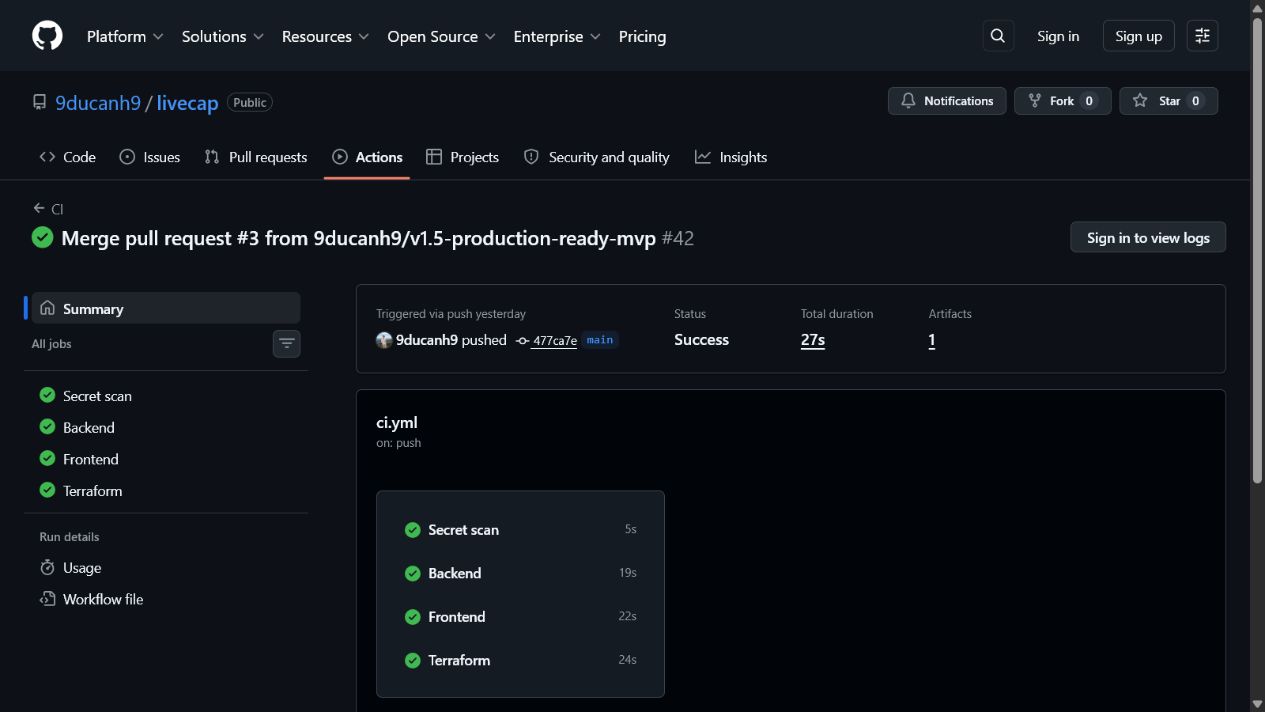
CI is validation-only. The workflow does not deploy, run terraform apply,
destroy resources, or migrate Terraform state.
Functional Testing
Backend – 204 Unit Tests
cd backend
python -m pytest -v
The test suite covers:
- WebSocket session lifecycle (open, audio, close, timeout)
- Session registry (global and per-IP limits)
- Transcribe stream management (start, partial results, finalize)
- Translate integration (finalized-only, language selection)
- S3 export (TXT serialization, presigned URL generation)
- Error handling (Transcribe error, connection drop, cleanup)
All 204 tests pass on Python 3.11. Running time: approximately 8 seconds.
Frontend – 11 Vitest Tests
cd frontend
npm test
Covers: component rendering, WebSocket hook state transitions, session timer, and microphone permission error states. Zero production vulnerabilities at release time.
Terraform – Syntax Validation Only
CI never applies infrastructure. It validates format and syntax only:
terraform -chdir=infrastructure/terraform fmt -check
terraform -chdir=infrastructure/terraform init -backend=false
terraform -chdir=infrastructure/terraform validate
Secret Scanning with Gitleaks
gitleaks detect --source . --verbose
Gitleaks runs against the full Git history. A clean scan is required before any
git push.
Logs and Metrics
CloudWatch Application Logs
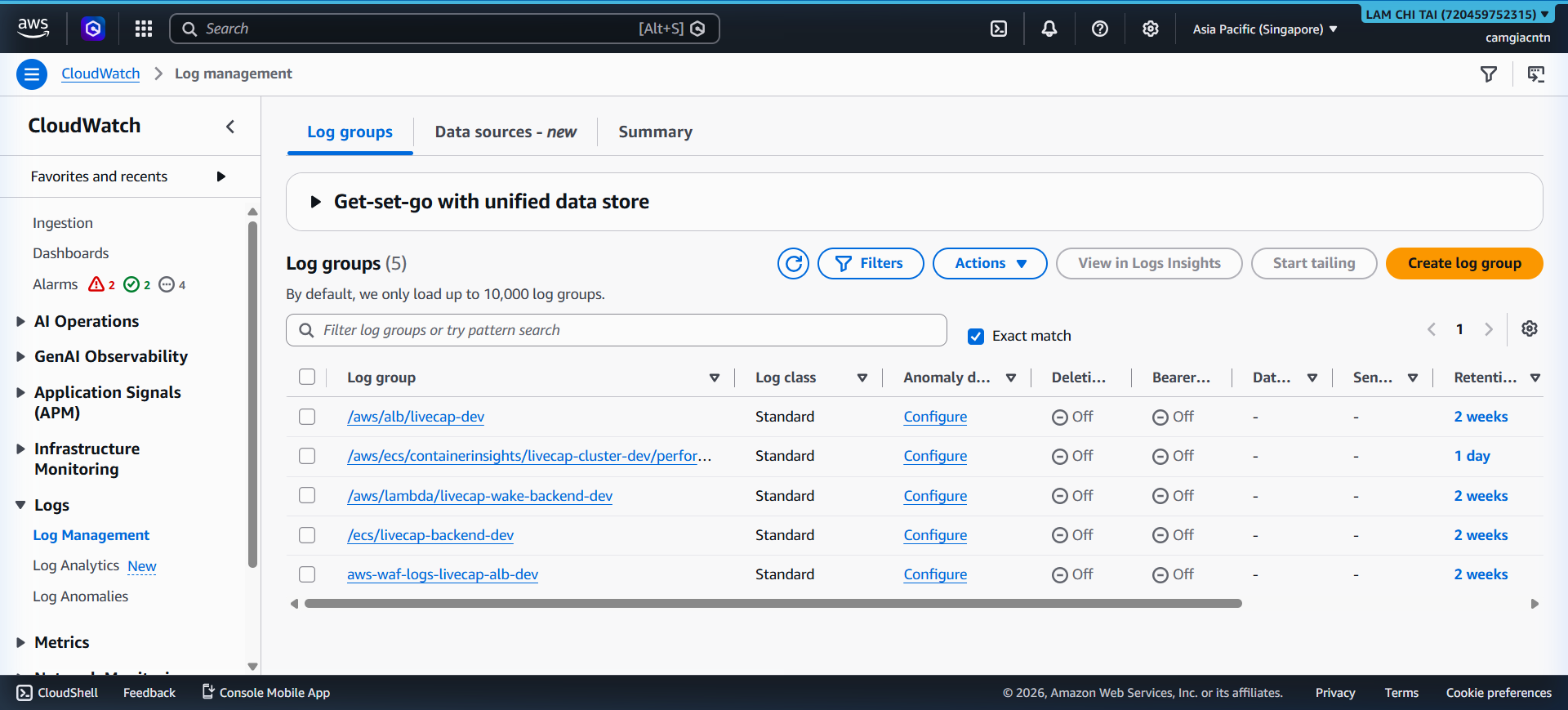
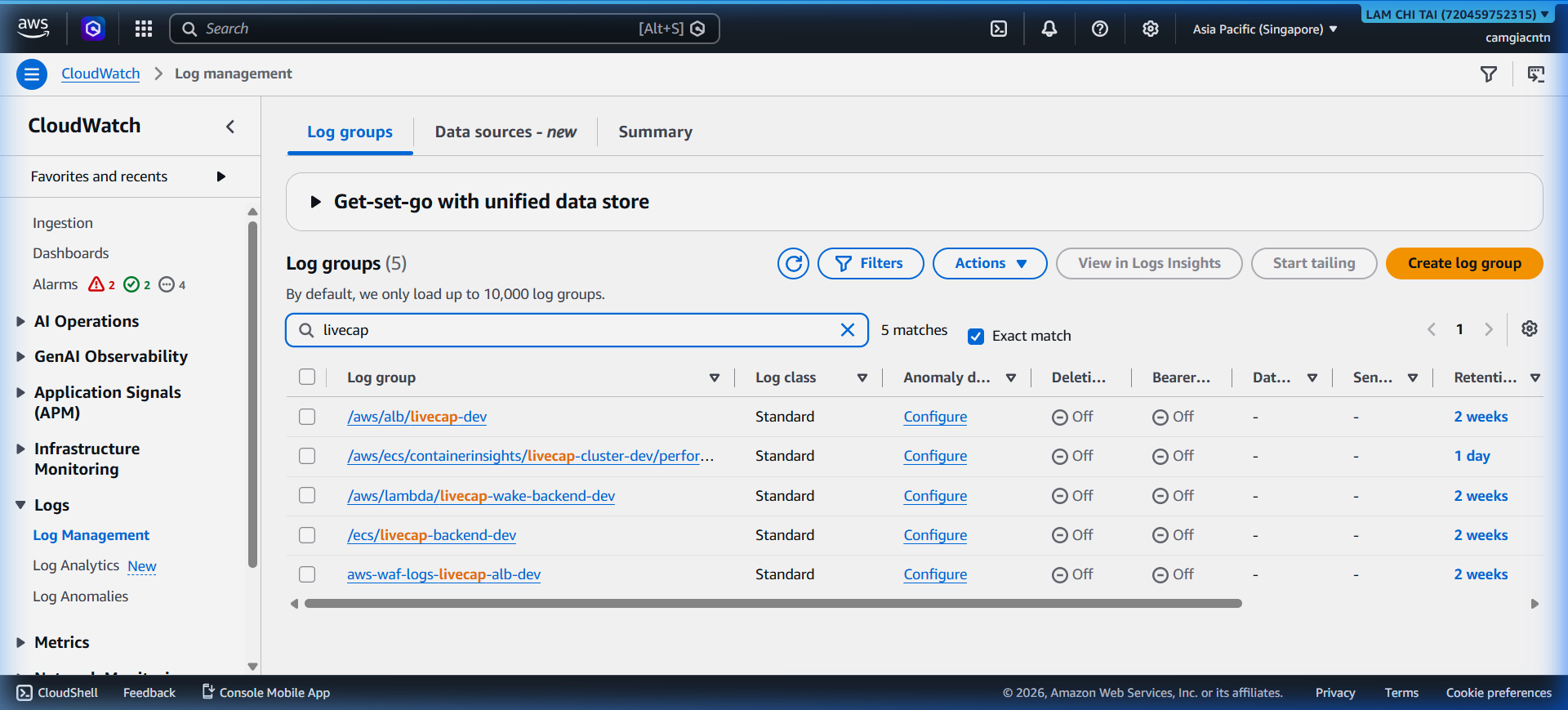
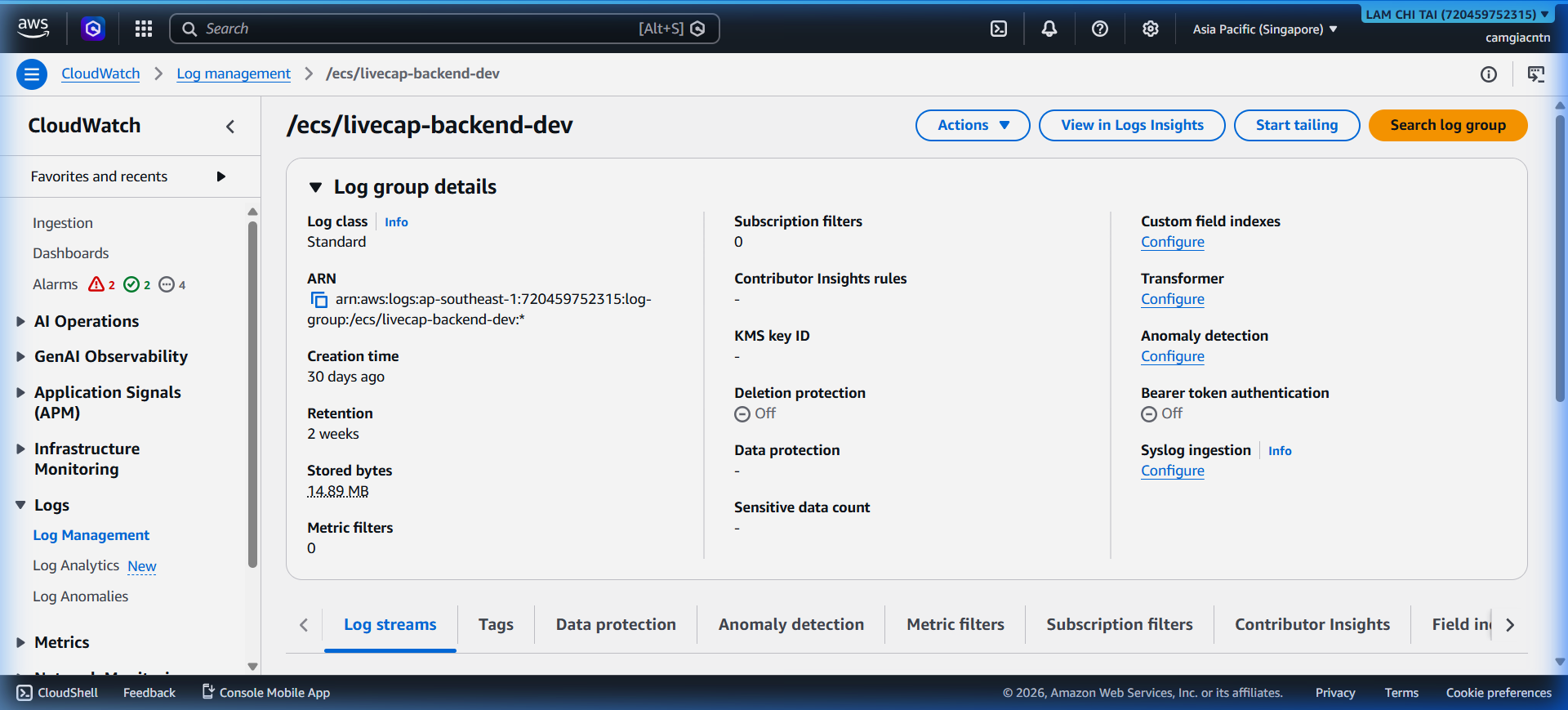
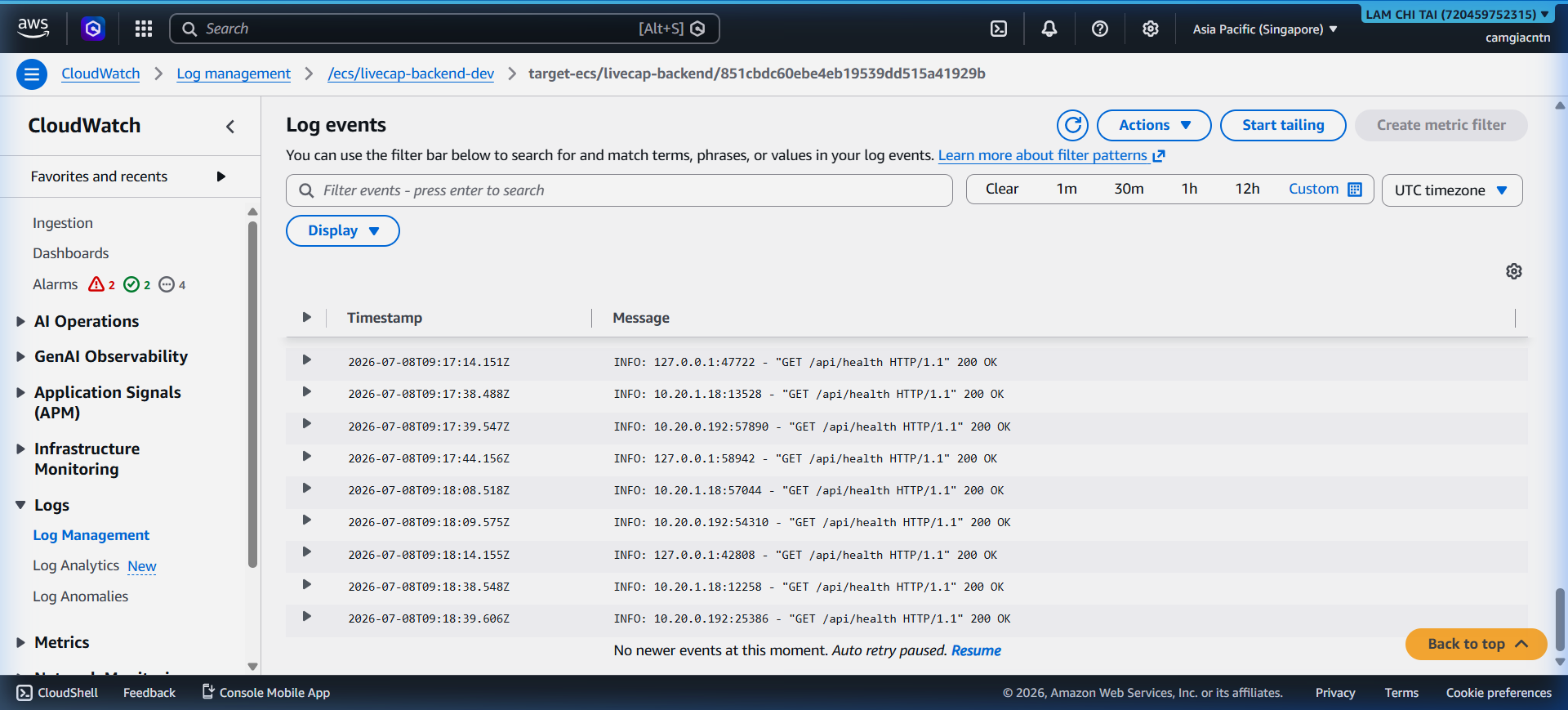
The FastAPI backend emits structured JSON logs to the /ecs/livecap-backend-dev
CloudWatch log group. Log retention is 14 days.
# Stream live logs
aws logs tail /ecs/livecap-backend-dev --follow --region ap-southeast-1 --profile <aws-profile>
Key log events you will see during a session:
session_start– new session opened, with session ID and client IP hashwebsocket_connect– WebSocket connection establishedwebsocket_disconnect– client disconnected or timed outsession_end– session closed, with duration and reasonintegration_error– error from Transcribe, Translate, or S3
Key Metrics to Monitor
| Metric | Source | What it tells you |
|---|---|---|
HTTPCode_Target_5XX_Count | ALB | Backend errors returned to CloudFront |
HealthyHostCount | ALB Target Group | Number of healthy Fargate tasks |
CPUUtilization | ECS | Task CPU usage (alert if > 80%) |
MemoryUtilization | ECS | Task memory usage |
BlockedRequests | WAF | WAF is actively blocking threats |
4xx/5xx error rate | CloudFront | End-to-end error rate |
Setting a CloudWatch Alarm (Example)
Create an alarm that fires when the ALB returns 5XX errors:
aws cloudwatch put-metric-alarm `
  --alarm-name "livecap-alb-5xx" `
  --metric-name "HTTPCode_Target_5XX_Count" `
  --namespace "AWS/ApplicationELB" `
  --statistic Sum `
  --period 300 `
  --threshold 5 `
  --comparison-operator GreaterThanOrEqualToThreshold `
  --evaluation-periods 1 `
  --alarm-actions "arn:aws:sns:ap-southeast-1:720459752315:livecap-alerts" `
  --region ap-southeast-1 --profile <aws-profile>
Security Controls
Already Deployed
| Control | Implementation |
|---|---|
| No root account usage | Deployment uses IAM user camgiacntn |
| IAM least privilege | Separate task execution role and task role |
| No hardcoded credentials | IAM roles only; no keys in .env, images, or Git |
| Private S3 frontend | Block public access + OAC origin |
| Private S3 transcripts | Block public access; presigned URLs expire in 24 hours |
| HTTPS everywhere | CloudFront terminates viewer TLS |
| WAF at CloudFront and ALB | Managed rules in BLOCK mode; rate-based rules |
| CORS restriction | ALLOWED_ORIGIN limits accepted frontend origin |
| Session limits | 4 global + 1 per IP prevent runaway Transcribe cost |
| Transcript expiry | 14-day S3 lifecycle rule; no raw audio stored |
| Secret scanning | Gitleaks runs in CI on full Git history |
| Immutable image tags | Git SHA tags prevent accidental latest drift |
WAF Verification
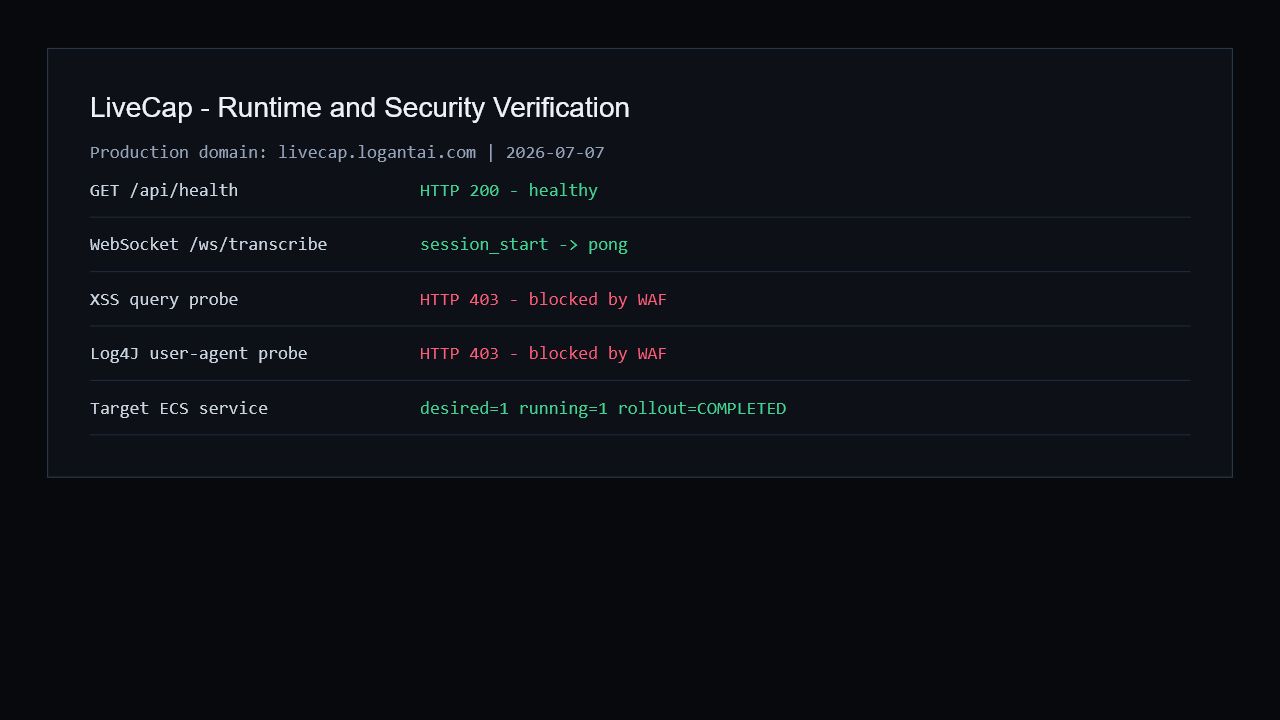
Both Web ACLs are in BLOCK mode. Production probes confirmed:
- Cross-site scripting (XSS) attempts → HTTP 403
- Log4J exploit strings → HTTP 403
Cost Optimization
Current Cost Drivers (ap-southeast-1)
| Resource | Cost basis | Optimization |
|---|---|---|
| ECS Fargate | Per vCPU-second + GB-second | Scale to 0 when idle (target feature) |
| ALB | Fixed hourly + LCU | Incurs cost even when ECS is at 0; only removed by destroying the full stack |
| NAT Gateway | Hourly + per-GB data | Single NAT in one AZ (cost trade-off) |
| Amazon Transcribe | Per minute of audio | Session limits cap usage |
| Amazon Translate | Per million characters | Only finalized segments are translated |
| CloudWatch | Log ingestion + storage | 14-day retention limits storage cost |
| WAF | Per ACL + per rule | Fixed baseline; worth it for blocking |
Cost-Saving Practices Already Applied
- 14-day log and transcript retention – avoids indefinite storage growth.
- Session duration limit (30 min) – bounds maximum Transcribe minutes per session.
- Session concurrency limits – prevent abuse-driven Transcribe/Translate costs.
- Translate only finalized text – partial/interim results are discarded before translation, saving characters.
- ECS scale-to-zero – Wake Lambda brings desired count from 0 → 1 on first request; idle scale-down returns it to 0 after inactivity.
Deployed AWS Budget
An AWS Budget alert is managed by Terraform at $50/month. It sends a notification directly to an email subscriber when actual or forecast spend approaches the threshold (not via SNS).
Note: Budget alerts are a delayed billing signal, not real-time enforcement. They help you notice runaway costs within hours, not seconds.