Enterprise Cloud Architectures and Industry Applications
| Field | Detail |
|---|---|
| Event name | Enterprise Cloud Architectures and Industry Applications |
| Date/time | 04 July 2026 |
| Location | AWS Event Hall, Floor 26, Bitexco Financial Tower, Ho Chi Minh City |
| Role | Participant |
Introduction
As a final-year Information Systems student and AWS Bootcamp intern, this event helped me see the gap between knowing a technology and using it to solve real business problems. The four sessions explored the cloud market and career visibility, practical Data Architecture, communication and Blue Ocean career strategy, and the responsible use of AI by freshers.
The most valuable outcome was not a list of isolated ideas. It was a set of standards I can apply to my career preparation and LiveCap: build real capability, understand business context, communicate decisions clearly, use AI without outsourcing understanding, and make my learning visible through consistent work.
Topic 1 – Nguyen Gia Hung: Cloud market, skill gaps, and career visibility
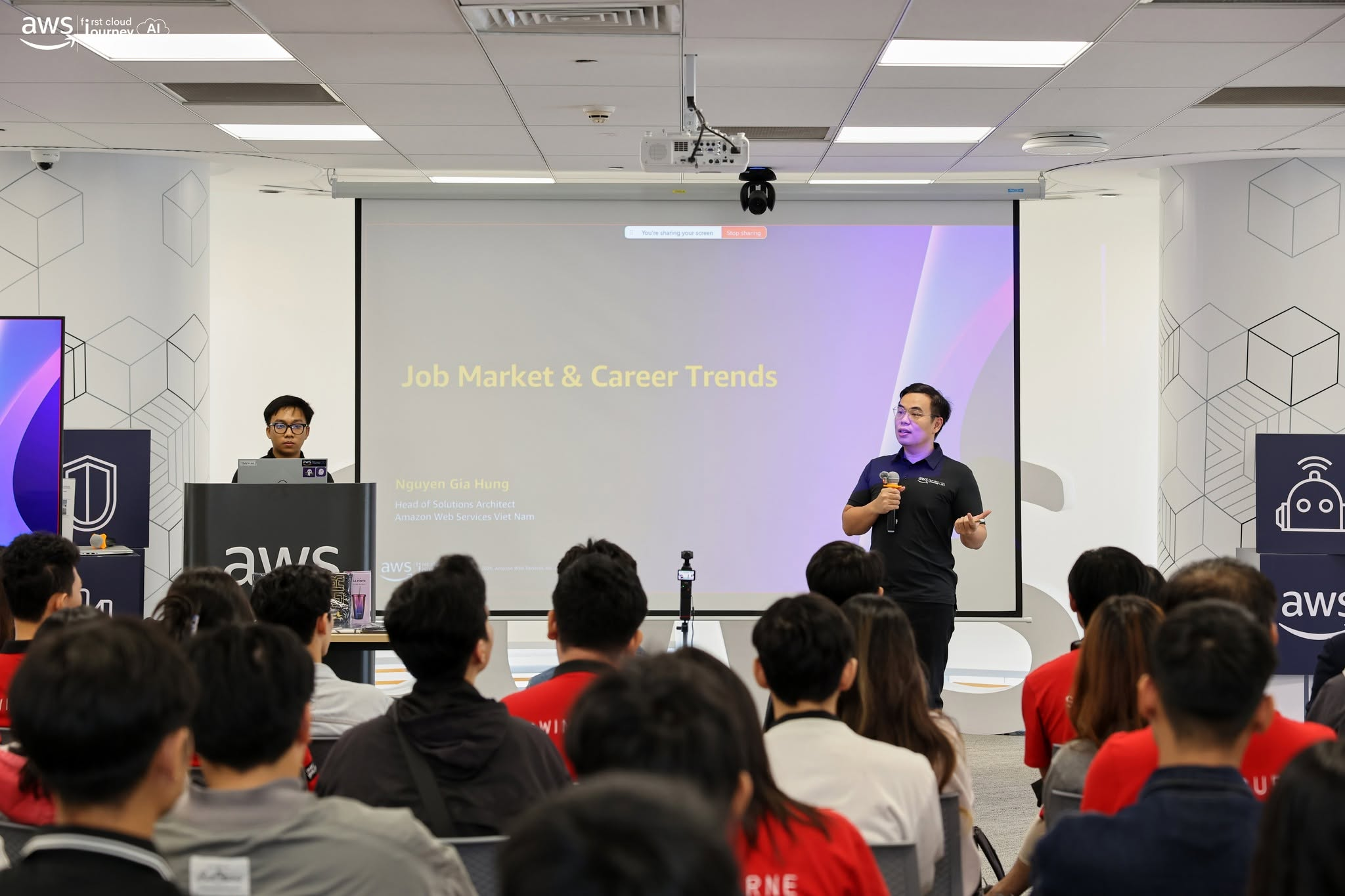
Nguyen Gia Hung discusses the job market, career trends, and capability development in cloud computing.
Nguyen Gia Hung explained that cloud-first is becoming a default direction for modern enterprises. Cloud Computing is therefore not only a technical trend but a long-term infrastructure and business strategy. AWS’s investment in Vietnam can be viewed through three pillars: local talent, infrastructure, and the next generation of builders.
The fact that most Amazon/AWS employees in Vietnam are Vietnamese demonstrates investment in local capability. Infrastructure such as CDN, caching, Local Zones, and low-latency platforms also reflects a long-term commitment. The third pillar matters directly to students: the market needs people who can build systems, not only remember theory.
AI is also making the entry-level market more demanding. It can support or replace some junior tasks while expectations for system thinking continue to rise. Even interns may be rejected when they lack an understanding of production systems, Kubernetes, or infrastructure. Degrees, certificates, and English remain useful, but they are only part of the entry ticket. Project depth and public evidence of learning make capability more credible.
The speaker summarized career development with this formula:
Result = Capability × Visibility × Consistency
Capability is real technical and problem-solving ability. Visibility is created through networking, GitHub, blogs, side projects, and communication. Consistency means continuing to learn and build over time. Some opportunities come from referrals and internal networks rather than public job posts. A project with clear source code, a README, deployment instructions, and architecture explanations is therefore stronger than one that only runs on a personal machine. Career positioning can also combine a role with a business domain, such as cloud/data in finance, retail, or manufacturing.
My lesson is that learning AWS services is not enough. I need to prove that I can build, explain, document, and improve a system. Certificates are useful signals, but they are not the final objective. In LiveCap, using Amazon Transcribe and Amazon Translate is only the starting point. The project must also show deployment, security, observability, cost, scalability, and operational documentation.
Topic 2 – Binh Cam Vinh: The practical gap in Data Architecture
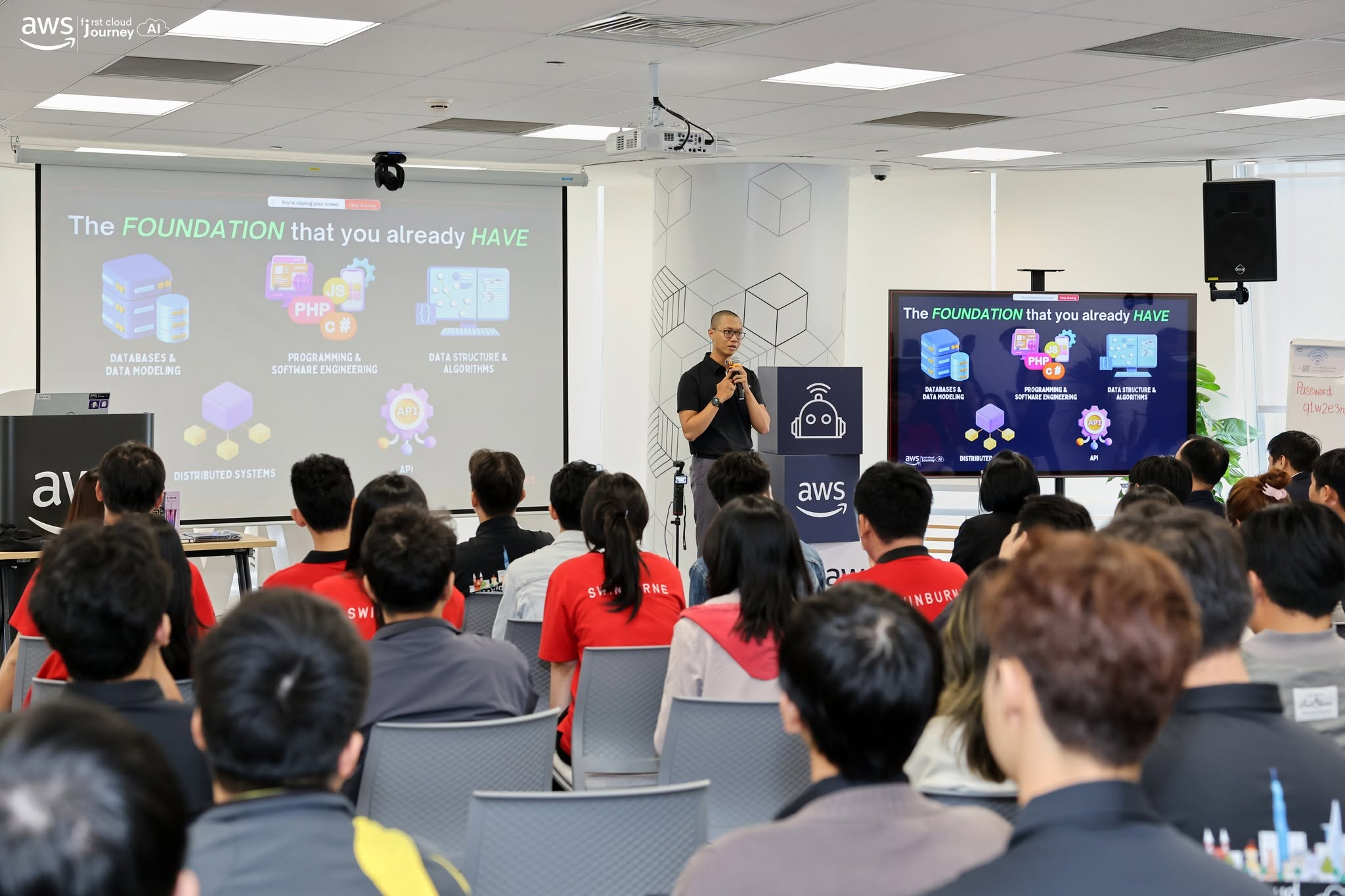
Binh Cam Vinh presents the technical foundations and system thinking required for a career in data.
Binh Cam Vinh contrasted classroom data projects with enterprise systems. At school, data is usually clean, small, and paired with clear requirements; mistakes mainly affect grades. In a company, data arrives from multiple sources, changes continuously, and may be defined differently by different departments. Requirements can change quickly, while an error may interrupt production, affect revenue, and damage trust.
The principle “One framework for every platform” means that students should not memorize tools in isolation. They need to understand the architecture or “DNA” of the field. In Data Engineering, the core framework may include collection, processing, storage, governance, and delivery. Once this flow is clear, tools and cloud services can be placed in the correct roles.
Experiences across startups, a large enterprise such as Heineken, and a fintech environment such as ZaloPay demonstrate that technical work changes with the context. A startup may build from scratch, a large organization must align business definitions across departments, and fintech systems must handle high traffic with minimal downtime. Engineers have to translate business requirements into technical language. AI can assist with code and reports, but it cannot replace business understanding, architectural judgment, and stakeholder communication.
I learned that Data Architecture is not simply choosing a database, ETL tool, or dashboard. The difficult questions concern data flow, definitions, ownership, reliability, and change. This foundation is relevant to Cloud/Data Platform Engineering, Business System Analysis, and Solution Architecture.
For LiveCap, I need to explain where transcript data originates, how transcription and translation outputs are processed or stored, which export formats users need, and how long data should be retained. The design should also account for interrupted sessions, incomplete data, service errors, and possible future analytics. These concerns turn LiveCap from a one-time demo into a small but realistic system.
Topic 3 – Nhu Tran: Overcoming fear, communication, and Blue Ocean strategy
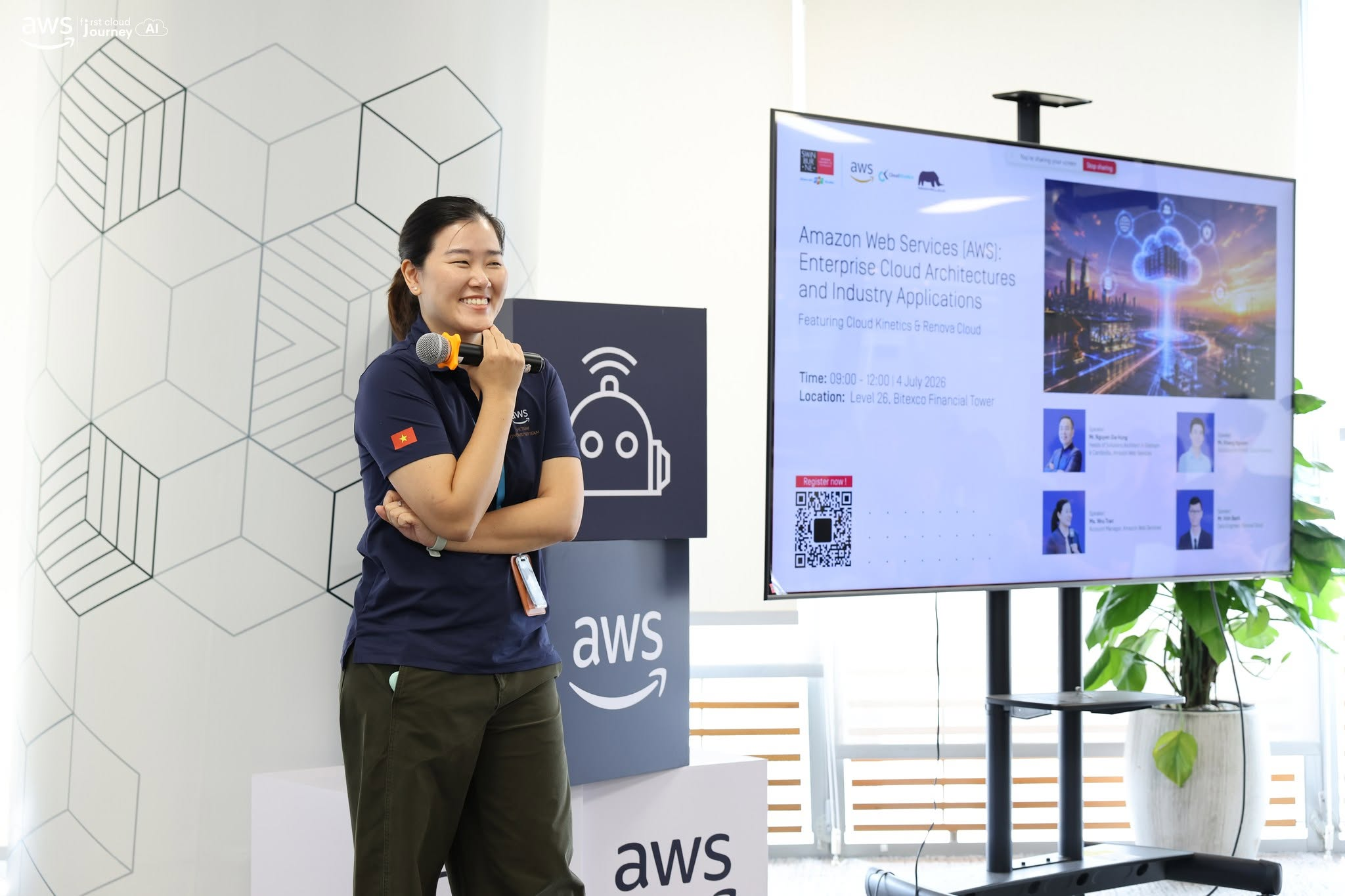
Nhu Tran engages with attendees at the Enterprise Cloud Architectures and Industry Applications event.
Nhu Tran explained that people often fear the consequences of mistakes—poor grades, judgment, or disappointing their families—more than the mistakes themselves. Fear of public speaking can similarly come from fear of evaluation. Open communication and repeated presentation practice can reduce that fear through real exposure.
Miscommunication often comes from different perspectives. A technical person may focus on creating value, while a salesperson focuses on communicating that value to customers. Effective communication requires understanding the intention behind a request. Small talk can also reduce distance from managers and create visibility around a person’s attitude, communication, and reliability without becoming self-promotion.
Applying only through job boards places students in a “Red Ocean” with many candidates. “Blue Ocean” opportunities can be created through relationships, trust, community participation, and consistent presence. The speaker described being rejected by Amazon ten times before a senior person recognized her dedication and introduced her to a Hiring Manager on the eleventh attempt. The lesson is not that relationships replace capability, but that reputation can make real capability visible outside a normal CV submission.
I learned that communication is not a soft skill separated from technical work. It affects requirement clarification, teamwork, interviews, and career opportunities. To move toward BSA or Solution Architect roles, I must ask better questions, identify hidden intentions, explain trade-offs, and build trust with stakeholders. I should also build visibility through communities, events, LinkedIn, GitHub, and project sharing instead of waiting until I feel completely ready.
LiveCap connects directly to this lesson because it addresses a communication problem: helping users follow workshops, meetings, and bilingual discussions more clearly. I need to present the project through user pain and value, not only through a list of AWS services.
Topic 4 – Khang Nguyen: AI mindset and long-term direction for freshers
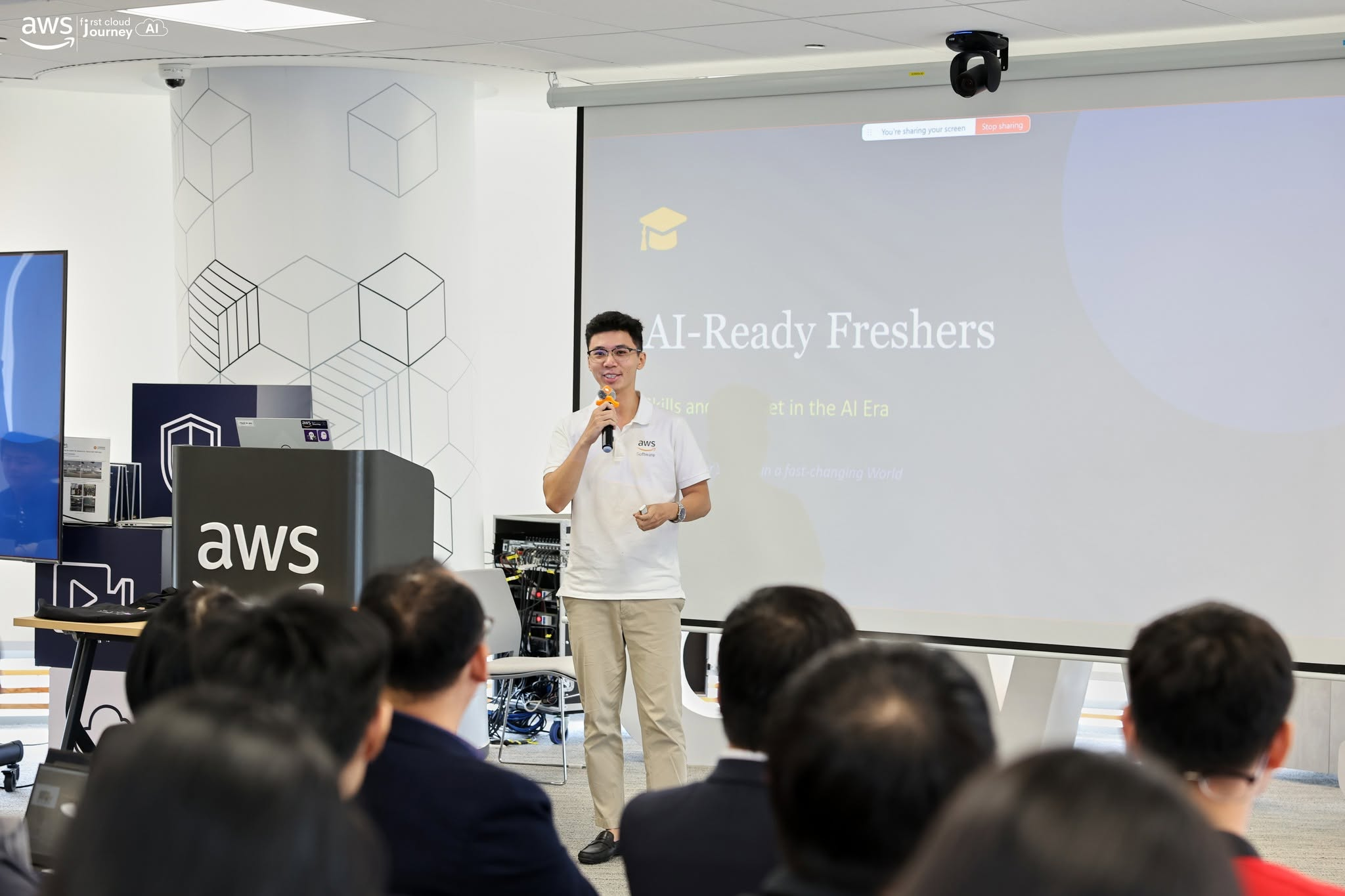
Khang Nguyen presents AI-Ready Freshers and the foundations students need in a fast-changing AI era.
Khang Nguyen shared the principle: “You can outsource thinking, but you cannot outsource understanding.” AI can accelerate work, but it cannot replace the user’s understanding. It acts as an amplifier: strong foundations help a person work faster, while weak foundations can make incorrect output difficult to detect. Students must continue building skills in programming, system design, cloud, data, and business.
When choosing a job, freshers should consider Passion, Responsibility, and Benefit. Benefit includes not only salary but also experience, network, knowledge, and personal development. A first role with good mentors, challenging problems, and practical exposure may create a stronger long-term foundation than a higher starting salary.
Companies may evaluate freshers through Attitude, Skill level, Experience, Exposure, and Talent. Attitude indicates learning potential and reliability, while Exposure reflects the diversity of projects and situations—not only years worked. The speaker recommended asking “why” to find root causes, building a long-term vision, working across functions, and maintaining consistency. Integrity in learning also means building beyond the minimum required for a grade.
I can use AI to accelerate coding, documentation, debugging, and architecture comparison, but I cannot delegate my understanding of AWS or requirements. In LiveCap, AI should be a reviewer and accelerator. I must explain CloudFront, S3, CloudWatch, Transcribe, and Translate, as well as why a target architecture might consider ALB, ECS/Fargate, or WAF. I also need to discuss the trade-offs involving cost, latency, security, scalability, and operations.
Lessons synthesized after the event
The four sessions reinforce one another. Nguyen Gia Hung showed that career growth requires Capability, Visibility, and Consistency. Binh Cam Vinh showed that real systems require architectural and business understanding. Nhu Tran demonstrated how communication, presence, and trusted relationships create opportunities beyond public applications. Khang Nguyen clarified that AI should amplify capability rather than replace understanding.
Technical skill is necessary but insufficient. My directions toward Cloud/Data Platform Engineering, Business System Analyst, and Solution Architect also require business context, communication, visibility, attitude, and consistent learning. These roles meet at the ability to understand needs, design systems, and explain solutions in both technical and business language.
Personal contribution and LiveCap action plan
After the event, I defined five concrete action areas:
Move LiveCap from a working demo toward production awareness. I will clarify the architecture, runtime flow, and purpose of each AWS service while distinguishing deployed components from the target architecture. Documentation should cover cost, security, logging, monitoring, and scalability.
Improve project visibility. I will keep the repository understandable, improve the README and setup guide, and document what I learned, what changed, and why. GitHub and LinkedIn can provide evidence of consistent learning rather than only showing a final result.
Understand users and business value. I need to identify who uses LiveCap, where they struggle, and which outputs help them after bilingual workshops or meetings. Transcript exports should be readable, structured, and reusable rather than merely downloadable technical data.
Use AI responsibly. I will use AI to review code, documentation, architecture options, and missing production concerns. Important suggestions must still be verified, and I must be able to explain the final decision. Verification remains the builder’s responsibility.
Prepare intentionally for my career. I will deepen my AWS, data flow, system design, and deployment knowledge while practicing both technical and business communication. I also need consistent participation in events, relationships, GitHub, blogs, and LinkedIn rather than concentrating effort only near deadlines.
Conclusion
Career readiness is not only about knowing tools. I need to understand systems, business, communication, AI, and how to make capability visible. My next step is to improve LiveCap as both a technical product and a portfolio artifact that demonstrates my learning process, production mindset, and career direction.