Event 1: AWS Study Group Technical Sharing
| Field | Detail |
|---|---|
| Event name | AWS Study Group Technical Sharing |
| Date/time | 09 May 2026 |
| Location | AWS Event Hall, Floor 26, Bitexco Financial Tower, Ho Chi Minh City |
| Role | Participant |
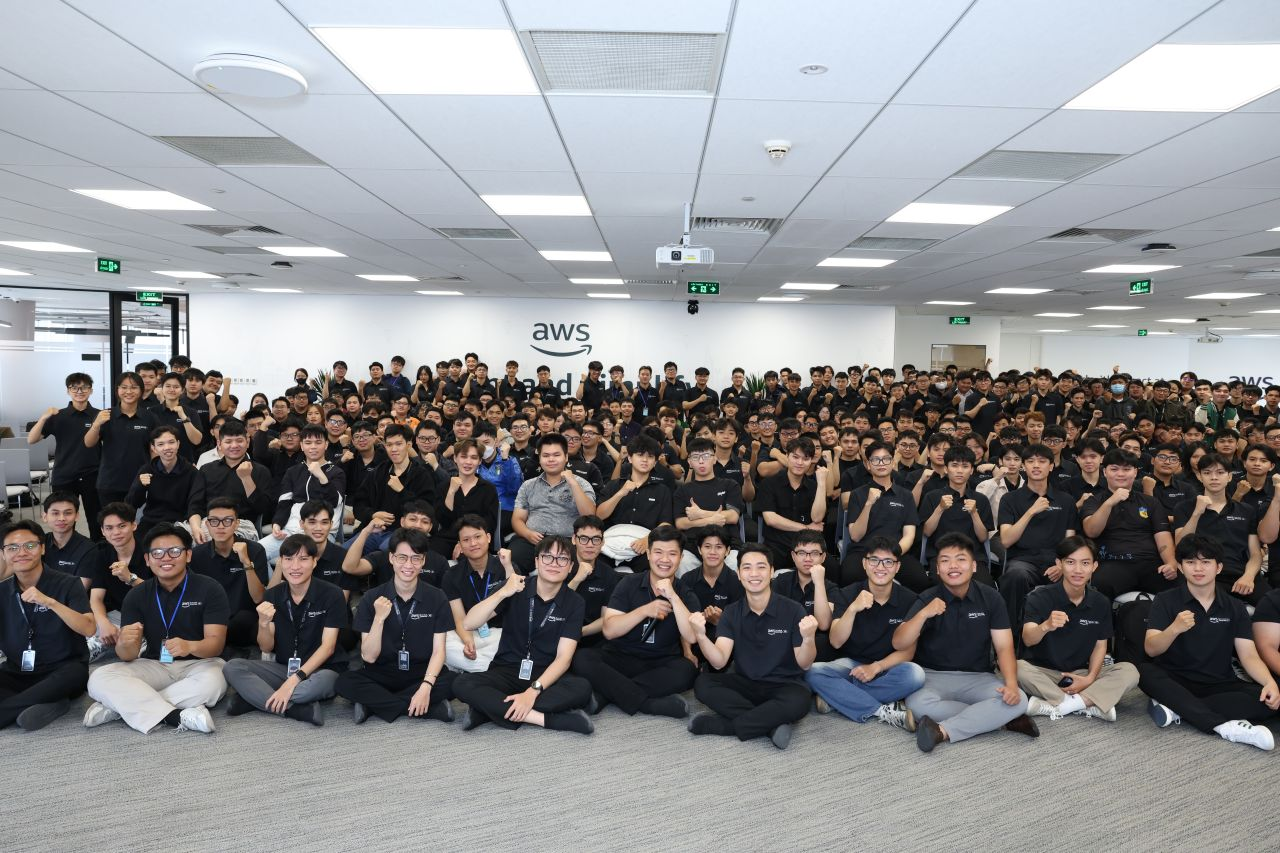
Speakers, organizers, and participants at AWS Study Group Technical Sharing.
The first event focused on a practical question for technology students today: how to learn more effectively, use AI appropriately, and prepare for a real working environment.
Although the four sessions covered different subjects, they shared one message: in the AI era, learners need more than tools. They also need a strong thinking foundation, the ability to ask questions, learning discipline, and a clear working process.
Topic 1 – Long Hoang: Addicted to Learning Like You’re Addicted to Social Media
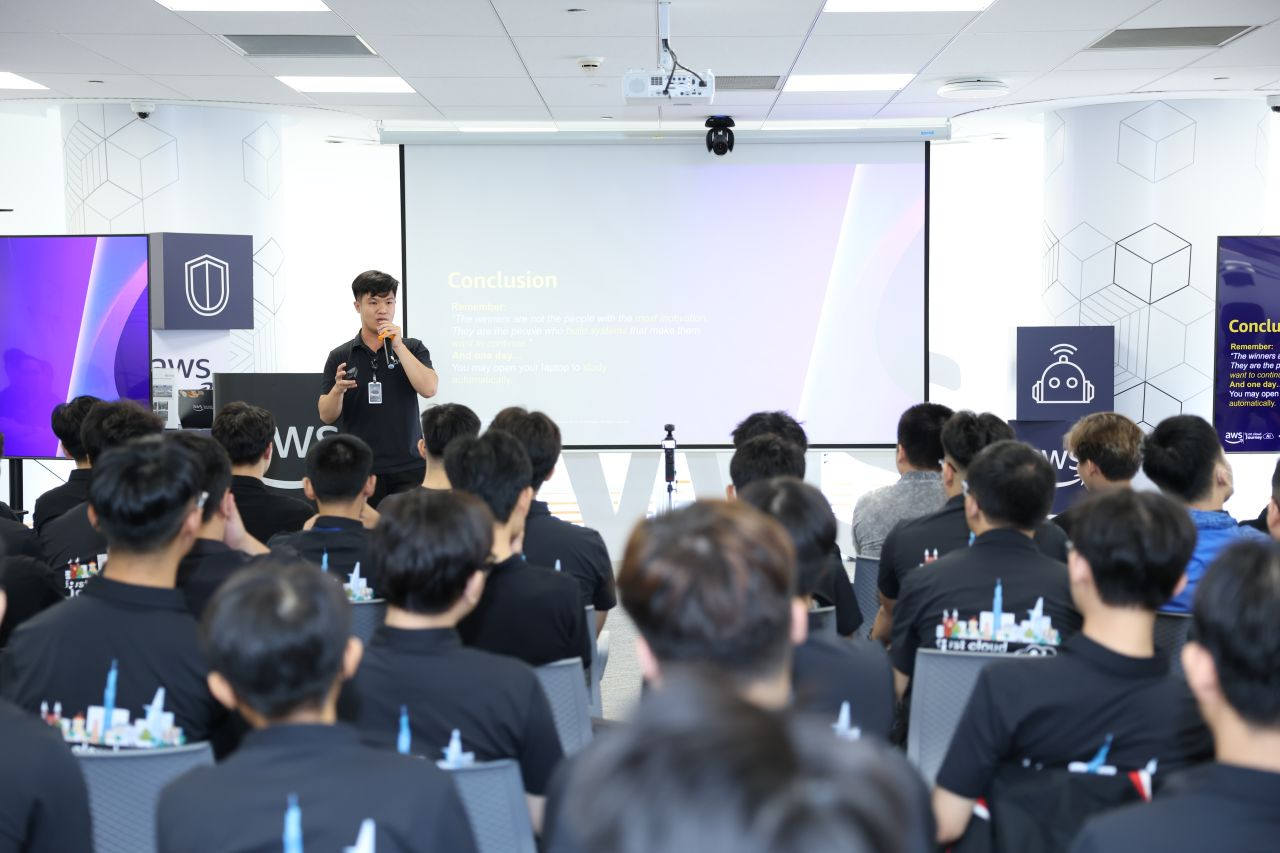
Long Hoang discusses how to build motivation and maintain consistent learning habits.
The first session explored how to make learning more engaging by applying mechanisms similar to those used by social media and online games.
People return to these platforms not only because of rewards but also because of the anticipation of rewards. Dopamine is associated not simply with receiving a result, but also with expecting that a reward is approaching. When this mechanism is applied carefully to learning, studying can become less repetitive and easier to sustain.
Some approaches I can apply include:
- Maintaining a daily learning streak.
- Dividing large goals into smaller tasks.
- Giving myself a reward after completing a milestone.
- Organizing learning as a system with levels, checkpoints, and achievements.
For example, instead of trying to “learn all of cloud in one month,” I can divide the goal by service: S3 today, IAM tomorrow, followed by Lambda or CloudWatch. This makes progress visible, reduces overload, and creates consistent momentum.
My main lesson was that learning discipline does not have to begin with forcing myself to study for long hours. It can begin by designing an environment in which tasks provide visible feedback, progress, and rewards.
Topic 2 – Thinh Nguyen: Automated Prompt Engineering – Enhancing LLM Output Quality
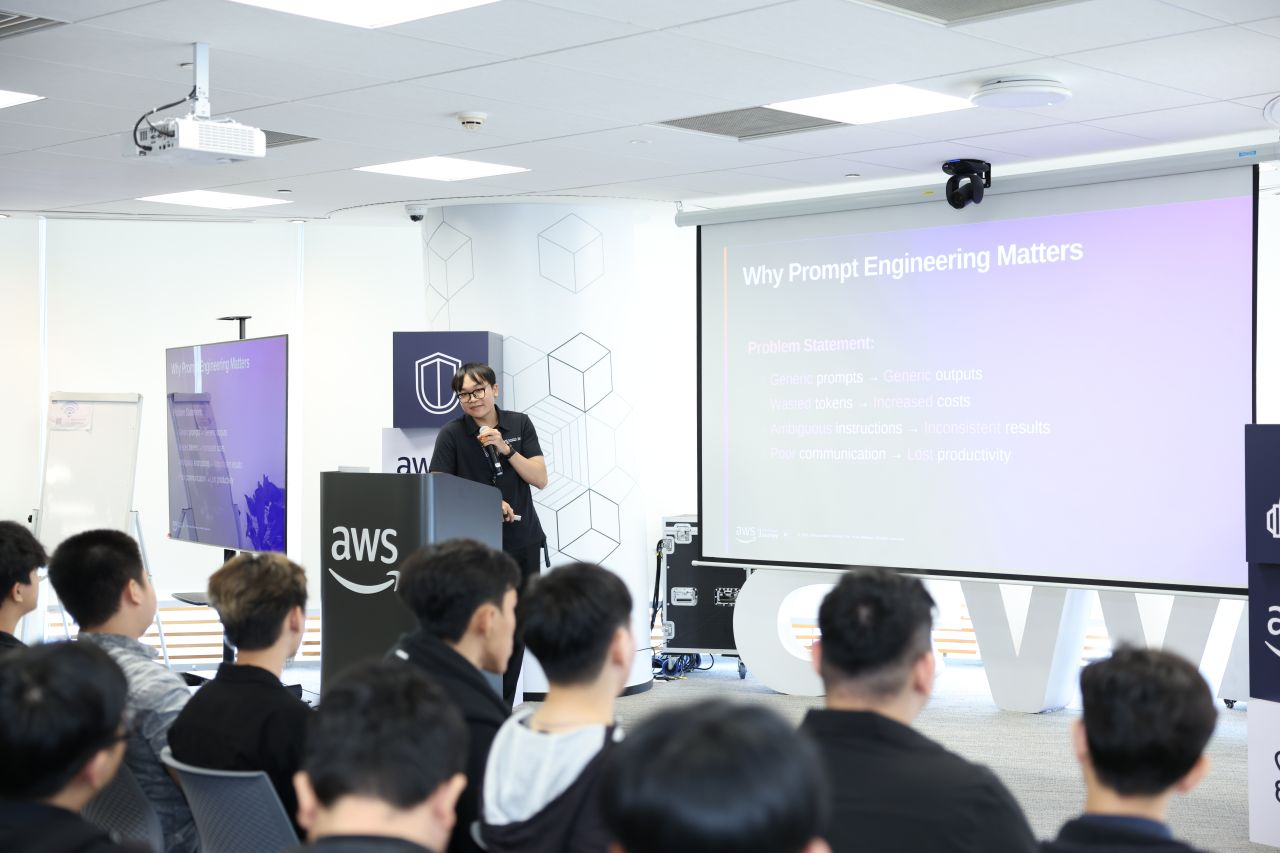
Thinh Nguyen explains how structured prompts improve the quality and controllability of AI output.
The second session examined Prompt Engineering as a method for communicating with AI more effectively. A useful prompt should have a clear structure containing seven elements:
- Role: The role assigned to the AI.
- Instruction: The task the AI must perform.
- Context: The situation surrounding the problem.
- Input: The data provided to the AI.
- Output format: The expected response format.
- Example: A sample illustrating the desired result.
- Constraint: Rules and limitations that must be followed.
AI cannot fully infer a user’s intention when a prompt is ambiguous. Clear roles, context, data, and output formats make results easier to control and verify.
The session also covered token usage and prompt optimization. Vietnamese input may require more tokens, so LLM users should consider input length, task decomposition, and the amount of detail actually required. Techniques such as Chain of Thought, Self-consistency, and Tree of Thoughts were also introduced for more complex reasoning tasks.
The most practical part for me was the AWS Prompt Optimizer demonstration. The application combined CloudFront, S3, Cognito, API Gateway, Lambda, Bedrock, and DynamoDB. It showed that turning AI into a real system involves authentication, backend services, databases, logging, security, and operating costs rather than only calling a chatbot.
My main lesson was that Prompt Engineering is not merely writing better questions; it is designing communication among people, AI, and software systems.
Topic 3 – Khang Nguyen: AI-ready Freshers – Skill and Mindset in the AI Era
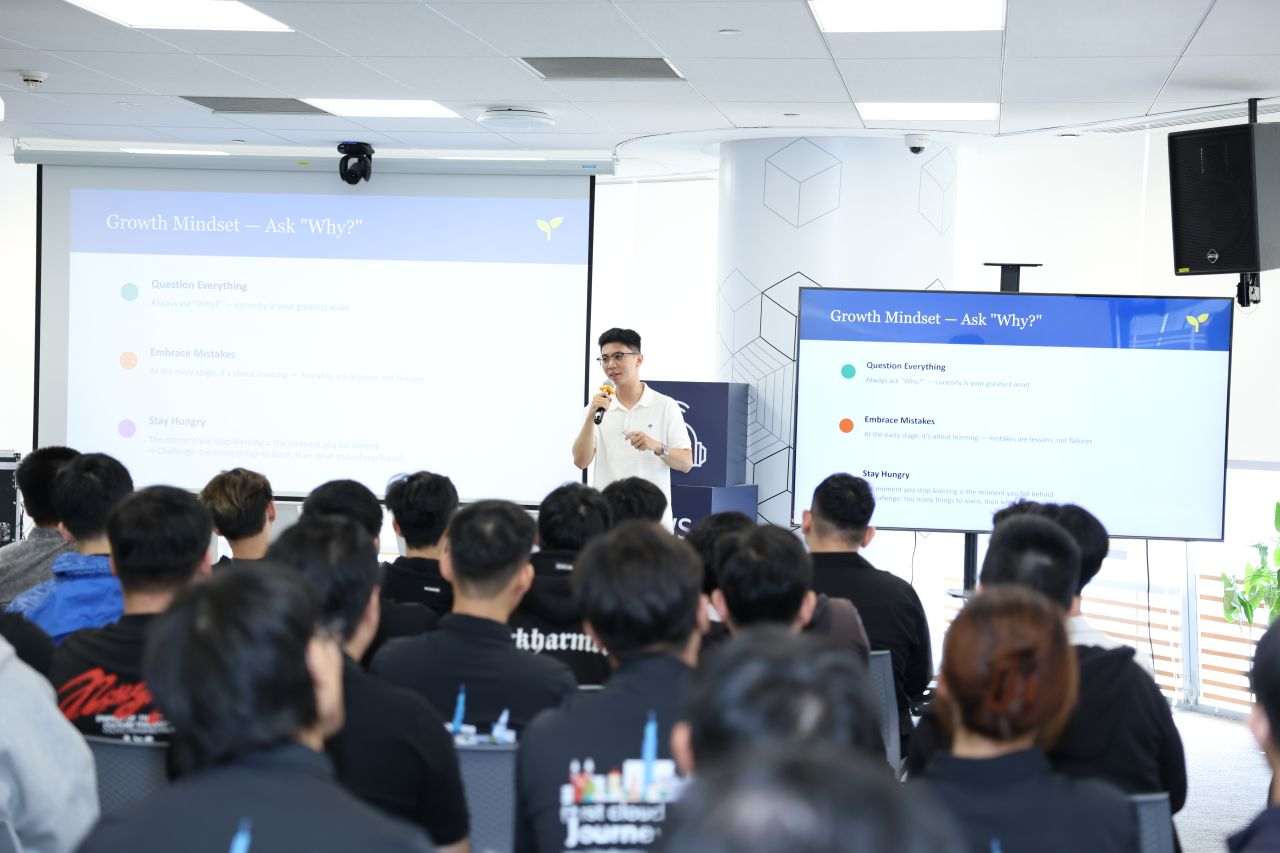
Khang Nguyen discusses the foundations, problem-solving mindset, and professional attitude expected from freshers in the AI era.
The third session focused on third- and fourth-year students preparing to enter the workplace while AI is developing rapidly. Its core message was: AI does not replace you; AI amplifies you.
Without a strong foundation, a person can become dependent on AI and struggle when the problem changes. With sound reasoning, however, AI can help that person work faster, extend their capabilities, and produce better results.
Companies do not necessarily expect freshers to know every new tool. More important qualities include:
- Fundamental knowledge.
- A problem-solving mindset.
- The ability to explain why a solution was selected.
- A serious professional attitude.
- Integrity—doing the right thing even when no one is checking.
Many technical decisions in a company are not absolutely right or wrong. A solution can be appropriate in one context and unsuitable in another. The question “Why?” is therefore often more important than “What?”. I need to understand not only what I am doing but why I selected that approach.
This topic relates closely to my interest in Solution Architect and Business System Analyst roles. Both require problem analysis, questioning, understanding trade-offs, and explaining decisions to others—not merely knowing how to use tools.
My lesson was that freshers should not only chase new tools; they need to build foundations, develop their reasoning, and take responsibility for their decisions.
Topic 4 – Thao Nguyen Phuong: BMAD Method – Bringing Agile and AI Roles into the IDE
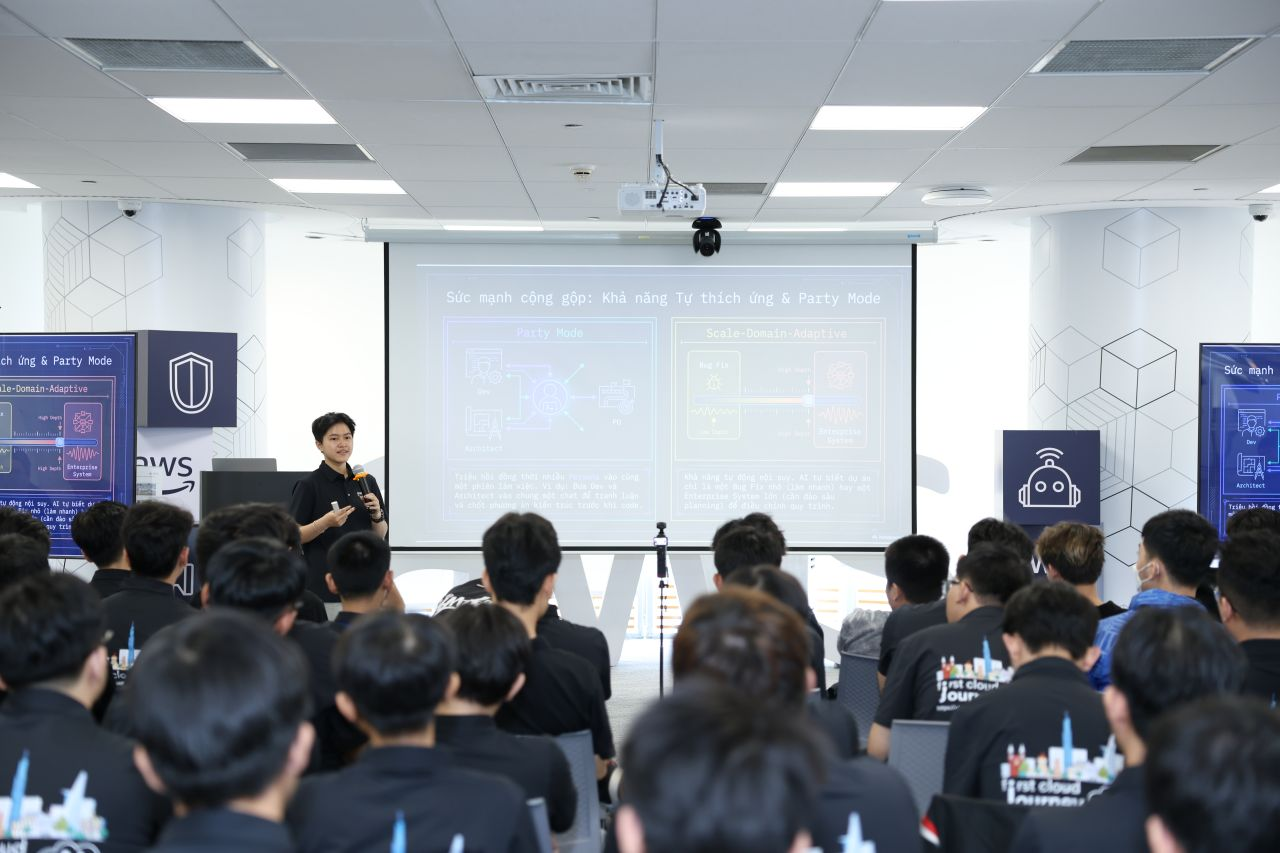
Thao Nguyen Phuong introduces the BMAD Method and a structured development process supported by multiple AI roles.
The final session introduced the BMAD Method, a more structured approach to using AI in software development.
A common problem in AI-assisted coding is placing too many requirements into one long conversation. Over time, the AI may lose context, misunderstand requirements, generate difficult-to-maintain code, or produce components that do not fit the existing system.
BMAD addresses this by representing a software process through several roles:
- A Product Manager analyzes needs.
- An Architect designs the architecture.
- A Scrum Master divides Epics into Stories.
- A Developer implements individual parts.
- QA/QC or a Reviewer tests and challenges the result.
Instead of asking AI to “code the entire project,” the method divides work into feature brainstorming, BRD creation, architecture design, story decomposition, story approval, implementation, review, and testing. This reduces context overload and gives people more control over quality.
The important point for me was that BMAD does not turn AI into a complete replacement for developers. AI can support multiple roles, but people still review, direct, and take final responsibility for the work.
My lesson was that effective AI-assisted development requires documentation, a clear process, well-defined stories, and continuous review rather than improvised prompting.
Overall reflection
After the event, I saw how the four topics form a connected picture:
- Effective learning requires carefully designed motivation.
- Effective AI use requires clear communication.
- Working successfully in the AI era requires foundations and a “Why?” mindset.
- AI-assisted software development requires a process, not only prompts.
My strongest takeaway was that AI does not reduce the value of fundamental knowledge. It makes that foundation more important because people with strong fundamentals can verify, direct, and use AI more effectively.
Overall, the event helped me understand that an advantage in the AI era does not come from using the most tools. It comes from learning quickly, thinking clearly, asking the right questions, and working responsibly.